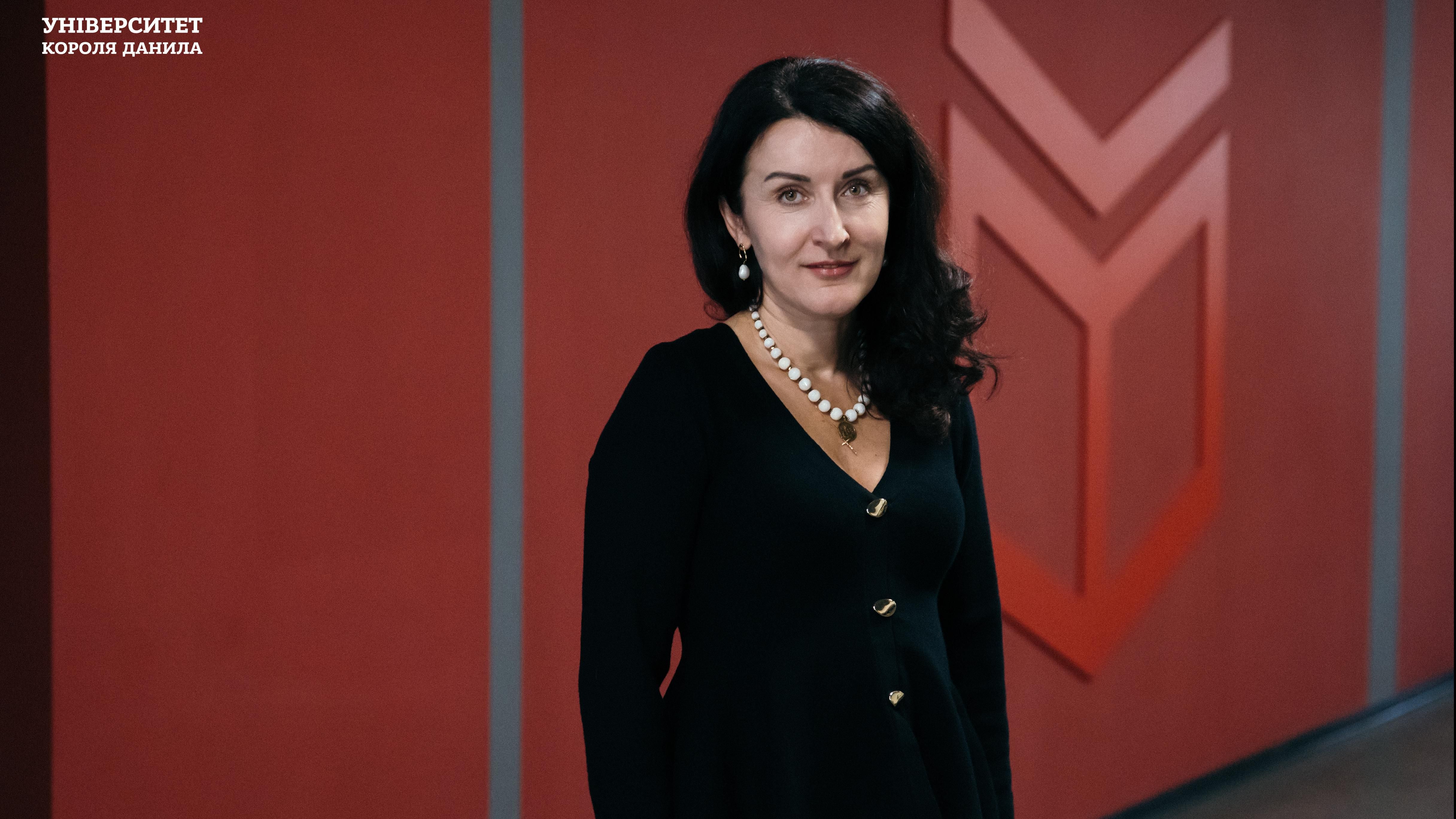
How can a legal solution be found when contradictions arise in a court of final instance regarding a particular issue? Scholars come to the rescue. One of them is Iryna Basysta, Professor at the Faculty of Law named after Academician Ivan Lutskyi at King Danylo University (KDU). For eight years, she has collaborated with the Scientific Advisory Board of the Supreme Court. She is also the author of numerous textbooks, manuals, and scholarly articles, and serves on the editorial boards of academic journals. In an exclusive interview, the scholar shared how she manages to combine different professional activities with teaching and where she draws her inspiration from.
– You received a letter of appreciation from the Scientific Advisory Board of the Supreme Court. What does this recognition and your long-term collaboration with the Supreme Court mean to you?
This is the result of many years of work with the Scientific Advisory Board of the Supreme Court. For me, it represents the professional growth of a scholar, when you gain an understanding of how things function in practice at the level of the final cassation instance in our country. You see the issues firsthand: where the legislation works and where it does not. Judges from the panels of the Cassation Criminal Court and the Grand Chamber of the Supreme Court- which unites judges from the four cassation courts: Civil, Commercial, Criminal, and Administrative - turn to us. There, exceptional legal issues are addressed at the level of the Supreme Court.
When I was first elected to the Board, I thought it might not be for me because it is very challenging: the work is voluntary, and you have to do it in your free time, which often comes late at night, so sometimes work continues from evening until morning. But it has been a wonderful experience in combining scholarship with practice. When you see how complex everything is at the cassation level, you start teaching differently. You try to show students that reality is not always as ideal as it appears in textbooks or manuals. Legislation may be perfectly written, but its application can vary. For example, excessive workloads, lack of time, and sometimes lack of experience among practitioners create precedents where even the simplest legal provisions are interpreted differently in Ivano-Frankivsk, Vinnytsia, or Kyiv. There are also gaps and conflicts within the legislation itself.
These are the objective circumstances that can lead to situations where two panels of the Supreme Court have different views on the same issue. They then turn to the members of the Scientific Advisory Board, and we prepare comprehensive opinions. Sometimes, we join forces with colleagues to produce a joint opinion because, as the saying goes, truth is born in discussion. Each request represents a new experience and a legal problem that, as a rule, has not yet been described by scholars.
– Society often sees the work of law enforcement agencies and courts in the media, but it does not see the work of scholars who form the foundation for the functioning of the entire legal system. Can this be compared to an iceberg, where only the tip is visible?
That’s roughly the case. People are not always familiar with the court system and do not realize the amount of preparatory work performed by court staff, judges, and consultants before, for example, a trial even takes place. It is enormous work. Our legislation is, in fact, quite high-quality, but of course, not always or entirely, and much also depends on the person tasked with implementing the legal provisions.
– Compared to colleagues in other countries, how has the workload for specialists in your field increased since the start of the full-scale war?
There have been many challenges, and at the beginning of the full-scale war, we all had to start learning anew: understanding how the International Criminal Court operates, what the specifics are in the classification of serious international crimes, and how all of this can be reconciled with Ukrainian legislation. After all, the evidentiary base is collected here in Ukraine, primarily for national law enforcement agencies, and may later be used in international proceedings.
Two years ago, our team prepared, at the request of the Main Investigative Department of the National Police of Ukraine, a guide for working with open-source digital information under the Berkeley protocol (an international standard for handling digital evidence), in comparison with the rules of our Criminal Procedure Code. The guide is designed to help pre-trial investigation bodies comply with both the international protocol and the national CPC, so that the evidentiary base for war crimes can be used in international judicial instances.
In reality, however, it was much more difficult for practitioners than for us scholars. We had time for self-education and could apply to participate in international educational and research programs, whereas practitioners had to work immediately on the ground: in Bucha, Irpin, Hostomel. They were developing investigative practices that did not exist anywhere else in the world.
– At a recent international conference, you presented on the specifics of building an evidentiary base for war crimes against the environment and the ongoing ecocide. How many other issues requiring legal regulation has the war brought to the surface?
I have some work related to the qualification and proof of genocide. But we all understand that this requires the political will of many countries, because the genocidal intent was not limited to the destruction of the Ukrainian nation. Unfortunately, judicial proceedings have not yet taken place. That is why cooperation is so important, so that evidence of everything happening is not lost. We sincerely believe that, ultimately, russia- as the aggressor and as a country committing genocide not only against Ukrainians - will be held accountable at the international level, and its leaders will face criminal responsibility.
– How is the teaching system for law students structured at King Danylo University? What do you aim to instill in young lawyers, and how do you motivate them to tackle difficult but necessary topics?
We motivate students in various ways, but the main goal is for them to develop as well-rounded individuals. For example, we watch law-related films- both international and Ukrainian. When students first enter the university, they often have no clear idea of what they want to become—an investigator, a prosecutor, a judge, etc.- or what that role actually entails. But as they study a particular subject, they can even analyze a fictional film from the perspective of legal violations, such as evidence collection or breaches of criminal procedure principles.
In one recent case, the group was not fully prepared for a class, so for the next session they approached it creatively and visualized 22 principles of criminal procedure. This is excellent, because studying the law purely in theory is not enough. Students need to develop as individuals and understand whether they are ready for this profession, with all its difficult and challenging aspects.
We therefore combine creativity, mock trials, films, essays, testing, theory, practical cases, and preparation of procedural documents. With master’s students, when analyzing current criminal procedure issues, we examine situations and exceptional legal problems drawn from the criminal cases I work on at the Supreme Court. We also visit investigative departments and local police stations so that students understand what the Unified Register of Pre-Trial Investigations is, how it functions, and how information is entered. When these processes are explained by an investigator, students perceive them in a completely different way.
– There was a time when you worked as an investigator. Why did you ultimately choose to focus on academic work?
I immediately realized that I am more drawn to scholarship than practice, although I did enjoy practical work. I take pride in seeing many of our graduates succeed—they perform well in practice, respect people and their rights. Seeing them as fully formed professionals, you understand that the volume of tasks they sometimes struggled with during their studies has ultimately benefited them.
– You write academic manuals, publish articles, serve on editorial boards, teach, consult in court, and continue learning. How do you manage to combine so many roles?
When you work with students, there is always that energy—they motivate you. You realize that your knowledge can be useful to others, because keeping everything to yourself and not sharing it isn’t right. So you have to make time. Sometimes it’s exhausting, but you come to a class, and everything falls into place.
– Nowadays everyone talks about artificial intelligence replacing specialists in various fields. Does this pose a threat to lawyers?
The threat is not AI itself, but rather its unethical use. First and foremost, AI is a technology that simplifies our lives. But there are areas where, theoretically, it could diminish human intellectual work—and that must not happen. AI can handle technical routine tasks very well, but it still requires final verification by a human. If we leave it unchecked, we risk losing our ethics and responsibility, which is ultimately up to us as professionals. Overall, AI cannot replace a judge or an investigator, because only a human is capable of empathy and genuine sensibility.
– How can AI save lawyers’ time?
It saves a lot of time on technical tasks, such as reviewing large volumes of literature, finding articles or court decisions, processing financial calculations, and so on. However, the results always need to be verified by specialists. And, of course, one should indicate when AI has been used, so that readers understand whether the work reflects human intellectual effort or the output of artificial intelligence.
– What is required to succeed in science? And what advice would you give to young researchers?
You need to tackle the work and not fear your mistakes, because we learn from them. Success in any profession depends on a person’s ability to self-organize and self-motivate. The art is not only in climbing the steps of progress, but also in having the resilience and determination to rise again after a fall. Of course, you also need to know how to live—notice when spring comes, when everything blooms around you—because that too motivates, inspires, and gives momentum to new scientific ideas and projects.
